Good AI, Better Business: It's Not About the Tools, It's About What We Do With Them
AI might be changing everything, but technology alone doesn't make better businesses. Reflections from the Good AI, Better Business panel on why confidence, critical thinking and human purpose matter most.
AI is changing the way we work, think and create. But doing more with technology doesn't automatically mean we're doing better business. It's what we do with it, who benefits and the opportunities we create that really matter.
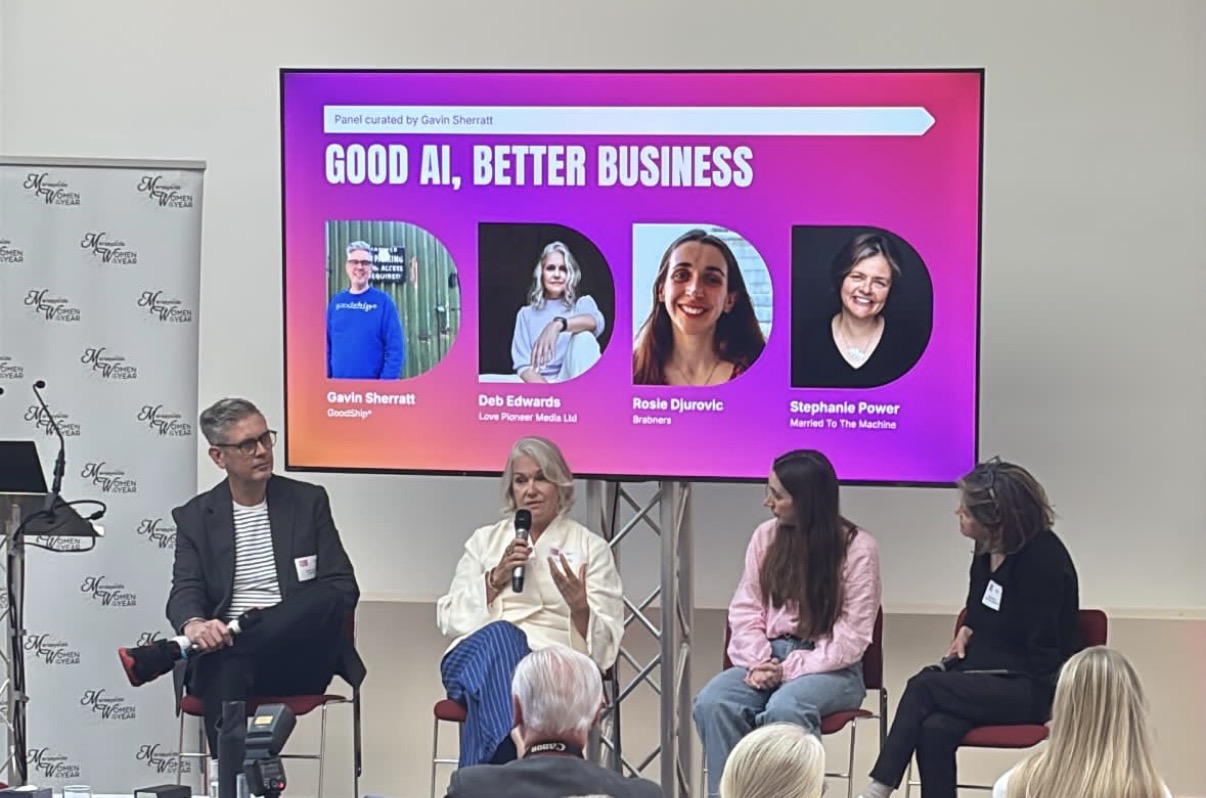
Today I had the pleasure of hosting the Good AI, Better Business panel at the Do Business Better Conference, organised by Ellie Kerr and Merseyside Women of the Year at Blackburne House in Liverpool.
We brought together three brilliant people with very different perspectives on artificial intelligence. Debbie Edwards, a coach and growth strategist exploring the relationship between emotional intelligence and AI; Rosie Djurovic, Head of AI at Brabners, who is helping shape the firm's approach to AI transformation; and Stephanie Power, a journalist, writer and co-host of the Married to the Machine podcast.
Different industries, different experiences and different ways of working with technology, but some really interesting common ground.
I didn't want this to become another conversation about how AI is going to change everything. We hear enough of that already. I wanted to understand what's actually happening, what people are learning, where things are going wrong and what businesses can do to make AI genuinely useful.
Because there's a big difference between adopting AI and doing something meaningful with it.
And I think that difference became the biggest theme of our conversation.
Stop chasing the technology and start asking better questions
One of the most interesting parts of the discussion came from Rosie and the work happening at Brabners.
Introducing AI into a law firm isn't simply about giving everyone access to a new platform. There are questions around governance, confidentiality, accuracy, culture and responsibility.
Brabners has been introducing Copilot over the past two years and is now rolling out Claude, but what stood out was how their approach has evolved.
Rather than trying to discover every possible way AI could be used, they're now concentrating on identifying the three most valuable use cases within each department.
I love the simplicity of that thinking.
What are the three things that could genuinely change how we work, improve what we deliver or give people more time to concentrate on the things that matter?
It's a much better starting point than buying another licence and hoping something useful happens.
And it's something we've been championing at GoodShip*.
We work with organisations of all shapes and sizes, and the conversations often start with somebody asking what AI tools they should be using.
But I'd rather start with a different question.
What are you trying to achieve, what's getting in the way and what would better actually look like?
Sometimes AI will be part of the answer. Sometimes it might be a different technology, a change in process or simply getting the right people around a table.
Technology shouldn't be the strategy. It should help us deliver it.
There's a human story behind the technology
Debbie brought something particularly important into the conversation.
Her work explores neuroscience, emotional intelligence and how we manage the pressures we experience in our working and personal lives.
She explained how her own experiences of grief and building a business led her to develop an audio-based framework that she could use herself and eventually share with clients.
She's now exploring how AI might help make that framework more accessible, offering people the opportunity to engage with it when they need support rather than always having to arrange a live coaching session.
It opened up some interesting questions about where technology and human experience meet.
How do you translate something deeply personal into a digital experience? How do you make sure the values and principles behind the work remain intact? And where should the boundaries be?
For me, that was a reminder that some of the most interesting possibilities for AI aren't necessarily about productivity or saving money.
They're about access.
Helping people connect with knowledge, guidance and opportunities that might otherwise be out of reach.
But we have to build those things responsibly. A digital tool can help make a framework accessible, but it doesn't automatically replace human judgement, relationships or professional support.
The human part still matters.
Perhaps more than ever.
The machine might sound confident, but that doesn't make it right
Stephanie brought a very different perspective from journalism, podcasting and research.
Her work depends on asking questions, investigating information and understanding where the answers come from.
She shared how she uses NotebookLM to explore trusted research material when preparing history podcasts. Rather than simply asking AI to tell her what happened, she provides material from sources she knows and then uses the technology to interrogate that information and trace where it came from.
That's an important distinction.
AI can be an incredible research assistant, but we still need to question the research.
We talked about hallucinations, fabricated information and the very real consequences of relying on answers that sound convincing but aren't accurate. Rosie highlighted examples from the legal profession where AI-generated references to cases that didn't exist have caused serious problems.
Stephanie also shared a brilliant way of thinking about confidentiality.
Imagine you're telling somebody gossip.
Would you be happy for that information to be repeated?
If not, think carefully before putting it into a public AI tool.
It's a simple analogy, but one that makes the risks easier to understand.
The conversation reinforced something I believe we're going to have to work much harder on as AI becomes part of education, business and everyday life.
Critical thinking is becoming more important, not less.
We need to be able to challenge the information we're given, understand the limitations of the technology and remain accountable for the decisions we make.
There's a danger that as AI becomes easier to use, we stop questioning what it produces.
We cannot allow convenience to replace curiosity.
Your team is already using AI. Are you helping them do it safely?
One of Rosie's strongest points was about businesses that haven't properly addressed AI adoption.
If you're not providing people with the right tools, there's a good chance they're finding their own.
And while that curiosity and willingness to experiment is positive, it also creates risks.
What happens when employees share commercially sensitive information with public AI platforms? What happens when client data, intellectual property or confidential documents are uploaded without understanding where that information might go?
Ignoring AI isn't a strategy for managing those risks.
Businesses need to be creating environments where employees can use appropriate, secure tools, understand the boundaries and feel confident asking questions.
But I think there's something else here.
It can't just be about rules and restrictions.
If we want people to adopt technology responsibly, we need to invest in their understanding.
Give them opportunities to learn, experiment, make mistakes safely and discover where the technology can actually help.
And we need to listen to the people doing the work.
They're often the ones who understand the frustrations, inefficiencies and opportunities far better than anybody else.
AI transformation shouldn't simply be something that happens to employees.
They should be part of shaping it.
You don't need 20 AI tools to do something brilliant
We had a good conversation about the tools everyone is using, and unsurprisingly, there wasn't one magic answer.
Stephanie talked about Perplexity, NotebookLM and Riverside, helping her with research, recording interviews and finding useful material without handing over her editorial judgement.
Rosie shared how she uses Gemini's voice capabilities to explore ideas while on the move, and some fascinating experimentation with smaller language models, including building applications for her children within controlled, local environments.
Debbie talked about ChatGPT and exploring Claude, but also made a very sensible point for smaller businesses and solopreneurs.
Don't overcomplicate it.
I shared how we're using Granola to capture conversations and Lovable to rapidly turn ideas into working prototypes.
All different tools, solving different problems.
And that was the point.
The best AI toolkit isn't necessarily the one with the most subscriptions or the newest features. It's the one that helps you do the things you actually need to do.
We also touched on the growing opportunities around smaller, more specialised language models, where organisations may not need enormous general-purpose systems to solve very specific challenges.
That's going to be an interesting space to watch, especially around cost, data protection and giving organisations more control.
But whatever the technology, the question remains the same.
What value is it creating?
Because buying AI doesn't mean you've become innovative.
Confidence is the real opportunity
One of the closing messages from Debbie was particularly important.
Just have a go.
Don't be frightened of the technology, don't feel you have to understand everything and don't assume it's something for somebody else.
And particularly for women who might not have traditionally seen technology as their space, there's an opportunity to challenge that thinking.
This really connected with me because it's at the heart of why we created AI Activator.
Through our work with Liverpool John Moores University and other partners, we've been bringing people together from different backgrounds and disciplines, giving them real challenges to solve and encouraging them to use AI, technology, imagination and critical thinking to develop new ideas.
We're not trying to turn everybody into an AI engineer.
We're trying to build confidence, creativity, curiosity and the bravery to have a go.
We've seen students who were initially unsure about using AI go on to research complex challenges, work with businesses and charities, develop working prototypes and confidently present their thinking.
And I've seen the change that happens when somebody realises they can create something they never imagined they'd be capable of building.
That's worth far more than learning how to write a clever prompt.
It's about creating opportunity.
Talent is everywhere. Opportunity isn't.
And if AI can help us open more doors, we have a responsibility to make sure those doors are open to more people.
That means thinking beyond the technology itself and investing in the skills, education, access and communities that allow people to participate.
AI & Tech for Good isn't just about doing good things with AI
This conversation also reinforced why we created AI & Tech for Good with Generative Minds.
We wanted to create a space where people from different industries, backgrounds and experiences could come together to explore the opportunities and challenges of emerging technology.
Not another room filled with people telling us AI is going to save the world.
And not a room where we're simply frightening people about everything that might go wrong.
Somewhere in the middle, where we can have useful, sometimes difficult conversations and start asking better questions.
How can technology help tackle real problems? How do we make sure people aren't left behind? How do we balance innovation with responsibility? And how do we give more people the confidence and opportunity to shape what's coming next?
That's why conversations like today's matter.
Because no single industry, organisation or technology company has all the answers.
We need different perspectives in the room.
We need people who challenge the technology, not just people who champion it.
And we need to make sure those conversations translate into action.
Three things to do tomorrow
At the end of the panel, I asked everyone for one piece of advice that people could take away.
Debbie encouraged people to simply start experimenting. Have a go, build your confidence and don't let the language around AI become a barrier.
Rosie challenged employers to provide secure, enterprise-grade tools and start building a responsible approach to AI rather than leaving employees to work things out for themselves.
Stephanie encouraged people to follow credible commentators, question the headlines and spend time understanding what's really happening rather than getting caught up in the hype.
I think those three messages work brilliantly together.
Be curious. Be responsible. Keep questioning.
And I'd add one more.
Think about who benefits from what you're creating.
Good AI is about the choices we make
I've spent more than 30 years working with technology, creativity and businesses, and I've seen plenty of waves of innovation come and go.
There's always a new platform, a new promise and a new reason why everything is about to change.
And AI is undoubtedly one of the most significant changes we've experienced.
But the thing I've learned over those years is that the technology itself is rarely what makes the biggest difference.
It's the people, the ideas, the relationships and the decisions we make about how we use it.
That's a big part of what we're building through GoodShip*.
We're not interested in technology for technology's sake. We're interested in what we can make possible when we bring good people together, challenge conventional thinking and use creativity and technology to make a positive difference.
Sometimes that means helping a business discover a smarter way of working. Sometimes it's giving a student the confidence to imagine a different future. Sometimes it's helping a charity tackle a challenge it hasn't had the resources to address.
And sometimes it means recognising that AI isn't the answer at all.
Today's conversation reminded me that responsible AI adoption isn't simply about governance, software licences or productivity.
It's about people having the knowledge, confidence and opportunity to make informed choices.
If we're going to reshape the way we work and live with AI, we need to make sure we're doing it with people, not just to them.
Good AI isn't defined by the technology we use. It's defined by the choices we make, the people we empower and the difference we create.
A huge thank you to Debbie, Rosie and Stephanie for bringing such different perspectives, honest experiences and practical advice into the conversation.
And thank you to Ellie Kerr and the Merseyside Women of the Year team for bringing us together at Blackburne House and giving these conversations a platform.
We've got an exciting opportunity ahead of us.
Let's make sure we use it to do some good.
Let's keep the conversation going
At GoodShip*, we're continuing to explore the possibilities of responsible, accessible and purposeful AI through AI Activator, AI & Tech for Good and the work we do with businesses, educators and communities.
Whether you're looking to build confidence across your team, explore new opportunities with AI or bring an idea to life, it starts with a conversation.
Related GoodShip* service
Empowerment
Explore EmpowermentRelated GoodShip* service
Consultancy
Explore Consultancy
Gavin Sherratt
Founder · GoodShip*
Team member
Gavin founded GoodShip* to bring good people, good ideas and useful technology together around work that can make a genuine difference.
LinkedIn