AI growth means very little if people are left behind
As national leaders talk about AI growth, infrastructure and economic ambition, the real test is whether local people, businesses and communities gain the skills, confidence and opportunities to take part.
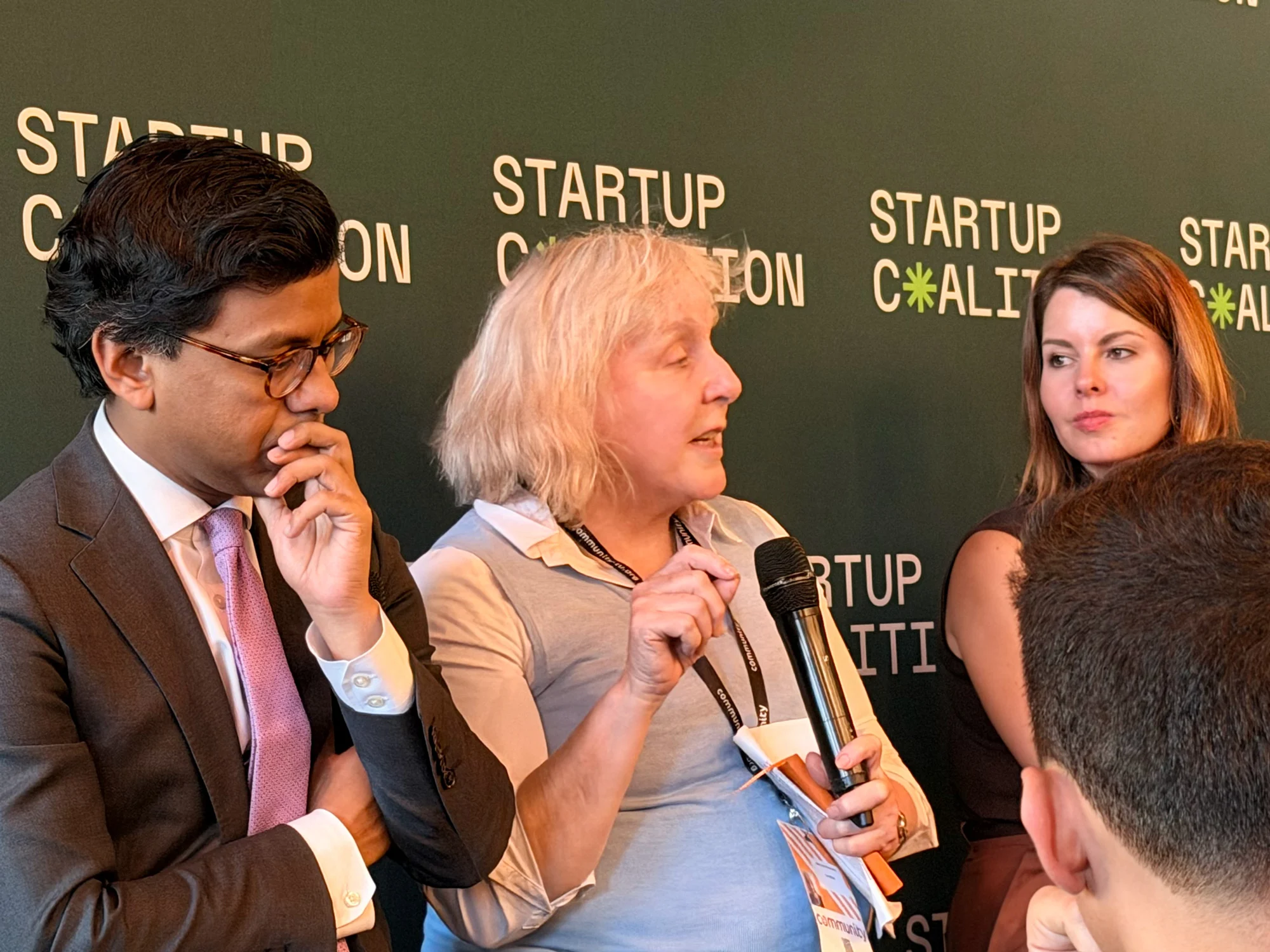
Yesterday I joined a discussion in Liverpool looking at AI Growth Zones, Tech Towns, sovereign AI and what all of this could mean for regional economies.
The timing made the conversation particularly interesting. It formed part of the Labour Party Conference fringe programme, on the same day that Andy Burnham delivered his first conference speech as Prime Minister just a short distance away in Liverpool. In that speech, Burnham put AI firmly into the wider conversation about Britain’s economic future, arguing that the country should put AI “centre stage” while being ambitious about the opportunities and clear-eyed about the risks. He also connected that ambition to skills, opportunity and working-class aspiration.
Against that backdrop, the fringe discussion felt particularly relevant. This was not simply a conversation about technology infrastructure. It brought together people working at national, regional and local government level to ask what AI-led growth should actually look like once it reaches places and communities.
Rt Hon Kanishka Narayan MP, the UK Government’s Minister of State for Artificial Intelligence, brought the national policy perspective around AI Growth Zones, sovereign capability, adoption and the role government can play in setting the direction of that adoption.
Kim McGuinness, Mayor of the North East, brought the perspective of a devolved region asking how major technology and infrastructure investment can translate into jobs, skills, business growth and opportunity for the people who live there.
And Cllr Mary Ann Brocklesby, Leader of Monmouthshire County Council and Chair of Cardiff Capital Region, brought the local and regional perspective from South Wales, where conversations about AI intersect with semiconductors, energy, infrastructure, education and regional economic development.
That mix of perspectives mattered. On the main conference stage, the Prime Minister was talking about Britain’s ambition to help lead the next technological revolution. In the fringe discussion, the conversation became much more practical: what does that ambition mean for individual regions, their businesses and, most importantly, their people?
There was plenty of discussion about infrastructure, investment, energy, data centres and the UK’s AI capacity. But the question underneath much of it was much more human:
Who actually benefits?
That was the part that connected most strongly with me, because building AI infrastructure is only part of the job. If investment arrives but local people do not gain the skills, confidence, jobs and opportunities that come with it, then we have not really changed enough.
The panel repeatedly came back to the idea that local benefit has to sit alongside infrastructure. Regions want jobs, skills, stronger local supply chains, affordable energy and a meaningful say in how AI is used, not simply more data centres appearing around them.
That feels closely aligned with the mission we have been building at GoodShip*.
Adoption is a people problem as much as a technology problem
One of the parts of the conversation that stayed with me came from Kanishka Narayan when he talked about what actually drives AI adoption.
He said:
“Feels like management quality matters a lot.”
And:
“Because if you hear from someone else that it's safe and it's okay and it helps you, then that's one of the biggest drivers of adoption.”
He also talked about the role government and the public sector can play:
“We can be the drivers of adoption there, both in terms of pressing the accelerator on speed, but also turning the steering wheel in terms of the values with which you do adoption.”
For me, one of the most important lines was this:
“Adoption in the service of augmentation rather than just automation, adoption that builds assurance and trust rather than undermines assurance and trust.”
That distinction between augmentation and automation matters.
The conversation around AI can become obsessed with how many tasks can be automated, how many jobs might change or how quickly organisations can deploy new technology. But there is another question that deserves much more attention:
What are we actually trying to make better?
How do we help people do better work? How do we improve services? How do we give people greater capability? How do we build confidence rather than create fear?
That is a very different starting point.
It also reflects something we see repeatedly in our own work. People often do not adopt technology because somebody tells them they should. They adopt it when somebody they trust shows them something useful, when they can experiment safely and when they can relate it to a problem they already have.
That was echoed throughout the panel, where trusted peers, management capability, practical examples and approachable learning were all discussed as important elements of adoption.
Skills cannot simply mean training more AI specialists
Kim McGuinness made another distinction that I think is critical.
She talked about supporting people not only with the skills needed to work directly in emerging AI-related industries, but also the skills they need to use AI inside an existing business or simply as part of everyday life.
She described one of the concerns she hears from businesses:
“I don't have time to learn how to do this.”
That was not Kim expressing her own reluctance towards AI. It was an example of the practical barrier she hears from businesses trying to understand a technology that is changing incredibly quickly.
Her response was the need to:
“give access to digestible training and skills”
And that sat alongside a much bigger regional ambition:
“We don't want to simply be consumers of AI.”
“We want to own both the data infrastructure, but then also the jobs, the development, the capability, all of those things around it.”
That captures an important distinction.
A successful AI economy cannot simply mean businesses and individuals becoming better consumers of technology developed somewhere else.
Regions need capability.
They need people who can build things, adapt things, question things and create businesses around them. They need educators who understand the changing environment, employers who can create opportunities and communities who can participate.
The skills challenge therefore goes much wider than training more AI engineers.
We need specialists capable of building the technology, but we also need people across existing businesses who understand how AI can help them work differently. We need public-sector teams able to use it responsibly. We need educators helping young people understand what these tools mean for their future. And we need to make sure people who currently feel excluded from technology can see a place for themselves in what comes next.
The panel described exactly this range of needs, from business adoption and public-sector capability through to career pathways and community access.
The danger is that we move quickly but leave people behind
Mary Ann Brocklesby gave perhaps the clearest warning of the discussion when talking about the scale of current provision:
“It's not enough. It's really tiny numbers that we're talking about and the inequality gap with AI will be bigger and bigger, quicker and quicker because of the pace of change.”
That should make all of us working around AI, education, business support and economic development pay attention.
Because speed cuts both ways.
The technology is developing incredibly quickly, creating enormous opportunity. But that same pace means existing inequalities can be amplified just as quickly.
If one group of people has the confidence, devices, networks, education and space to experiment while another does not, the gap between them can widen remarkably quickly.
The panel’s clearest concern around skills was not simply whether programmes exist. It was reach. Existing bootcamps, short learning programmes and apprenticeships were described as reaching too few people relative to the scale and speed of the change taking place.
This cannot therefore be solved by a handful of specialist bootcamps or one-off workshops.
We need a much broader culture of participation.
That is why we built AI Activator
This is the space we are trying to work in through AI Activator.
We created AI Activator because we do not believe another presentation about AI is enough.
People need somewhere to experiment. They need real problems to solve, other people to work alongside and permission to ask questions, get things wrong, make things and discover what they are capable of.
AI Activator puts people into multidisciplinary teams working on genuine challenges from real organisations. They research, question, create, prototype, collaborate and present, using AI alongside human creativity, judgement and problem-solving.
The objective is not simply to produce more people who can say they have “used AI”.
It is about helping people become more confident, curious and capable. It is about understanding the technology, but also questioning it. It is about developing communication, collaboration, critical thinking and problem-solving alongside technical capability.
Most importantly, it is about helping people imagine themselves participating in this new economy.
We have already seen the effect that can have. Through our work with Liverpool John Moores University, 87% of participants reported increased confidence and 80% said the programme changed how they thought about their career.
Those outcomes matter because confidence and visibility are often the first steps towards opportunity.
But programmes alone are not enough
That is also why we created AI & Tech for Good with Generative Minds.
AI conversations can very quickly fall into two camps. Either AI is going to fix everything, or AI is going to destroy everything.
Neither position is particularly useful if you are a teacher, business owner, student, charity, policymaker or community leader trying to work out what you should actually do next.
AI & Tech for Good creates a space where different voices can be in the same room.
Technologists alongside educators. Businesses alongside students. Founders alongside community organisations. People building the tools alongside people experiencing the problems those tools might help address.
The aim is not to persuade everyone to agree. It is to create a trusted space to learn, question, challenge and share practical experience.
That feels increasingly important because AI adoption is not simply a technology challenge. It is also a challenge of trust, confidence, leadership and community.
And that brings us back to Kanishka’s observation.
People are more likely to experiment when they see somebody they trust doing it successfully.
That means communities matter. Networks matter. Peer learning matters.
And creating spaces where people can talk openly about what is working, what is not working and what they are worried about matters too.
A regional bargain around AI
There was another idea running through the discussion that feels especially relevant for Liverpool City Region.
If places provide the land, energy, talent, universities, infrastructure and communities that make technology investment possible, there should be something meaningful coming back in return.
Not simply buildings, but jobs, skills, supply chains, opportunities, better public services, new businesses and confidence.
And, crucially, routes into those opportunities for people who currently do not have them.
The panel talked about regions building on their own strengths rather than every place trying to replicate the same technology cluster. The North East discussion included financial services, startups and university-linked innovation. South Wales brought in compound semiconductors and regional research and development, while other parts of the discussion looked at the relationships between AI infrastructure, energy and local economic development.
That feels very relevant here.
Liverpool does not need to become somebody else’s version of a technology city.
We already have powerful strengths across creativity, digital, health, education, gaming, music, advanced manufacturing, professional services, universities and the social economy, alongside a community of people who are prepared to collaborate.
The opportunity is to connect those strengths around AI, not replace them with it.
That is also why our work extends beyond individual programmes.
Through KinShip, we are building community and creating spaces for collaboration. Through our work with Liverpool Chamber and Navigate, we are helping connect businesses, skills, innovation and the future of work. And through GoodShip*, we are trying to turn some of these conversations into real programmes, prototypes, partnerships and opportunities.
Our starting question remains pretty simple:
What are you trying to make better?
That is where we think the most useful conversations begin.
What happens next?
For us, the next phase is about widening participation and building more partnerships.
We want to work with universities, colleges, schools, employers, charities, community organisations, public bodies and funders who want to create practical routes into AI and technology.
That could mean bringing AI Activator into an organisation or community. It could mean becoming a challenge partner and giving participants a real problem to work on. It could mean supporting a cohort so people who might otherwise miss these opportunities can take part.
It could also mean becoming part of AI & Tech for Good, sharing what you are learning and helping create a more informed conversation about what responsible and useful adoption actually looks like.
Because none of this works particularly well in isolation.
And this is personal for me too
I left school with no qualifications.
I was not somebody who looked like they were heading towards a career working across technology, creativity, digital businesses and innovation. I certainly would not have predicted that I would eventually be building programmes helping other people explore the future of technology.
That experience stays with me because I know that ability and opportunity are not distributed equally.
Some people get the right teacher, the right introduction, the right workplace experience or simply the right person saying, have you thought about trying this?
Others do not.
That is why the conversation about AI cannot only be about compute, infrastructure and economic growth. It also has to be about creating those moments of possibility.
Helping a student discover something they are brilliant at. Helping somebody who does not think technology is for them build something for the first time. Helping a small business understand how these tools can genuinely improve what they do.
And making sure that, as this technology develops at extraordinary speed, we do not allow another generation of people to drift past the opportunities it creates.
Talent is everywhere. Opportunity isn’t.
Creative thinking, technology and, most importantly, community can help change that.
That is the mission we are building at GoodShip*, and we want more people to be part of it.
If you want to understand more about AI Activator, get involved with AI & Tech for Good, bring us a challenge, support a cohort or explore how we could work together, come and talk to us.
We will also be exhibiting at the Liverpool City Region AI Summit on 27th October, where we will be sharing more about AI Activator and AI & Tech for Good, meeting people who want to collaborate and continuing the conversation about how Liverpool City Region makes sure the opportunities created by AI reach far beyond the technology sector.
Come and find the GoodShip* crew and say hello.
Let’s build hope. Let’s build bravery. And let’s build what comes next, together.
Related GoodShip* Activation
AI Activator
Don't just learn AI. Do something with it.
Explore AI ActivatorRelated GoodShip* service
Empowerment
Explore EmpowermentRelated GoodShip* service
Community
Explore Community
Gavin Sherratt
Founder · GoodShip*
Team member
Gavin founded GoodShip* to bring good people, good ideas and useful technology together around work that can make a genuine difference.
LinkedIn