TechTok Malta: the technology was impressive, but the conversations kept coming back to people
A day at TechTok Malta left me thinking less about the technology itself and more about people, confidence, responsibility, collaboration and how we shape what comes next.
I went to Malta for a technology conference. I came away thinking far more about people, confidence, responsibility, collaboration and the choices we are making about what comes next.
Last week I spent the day at TechTok in Malta, as part of a wider visit to continue building relationships between Malta and Liverpool and explore where some of the work we are doing through GoodShip* and AI Activator might connect.
I expected plenty of conversation about AI, developers, cybersecurity, cloud infrastructure, startups and emerging technology.
And there was plenty of that.
But the thing that stayed with me most was how often the conversation came back to people.
How we work. How we learn. How much judgement we are prepared to hand over to machines. How organisations introduce technology without losing sight of the humans inside them. How young people prepare for work that is changing before they have even properly entered the workplace. And how we make sure the opportunities created by AI are available to more than the people who already feel confident navigating them.
That felt very close to a lot of the thinking behind GoodShip*, AI Activator and the work we have been doing around AI & Tech for Good.
Increasingly, I think we need to spend a little less time asking what AI can do and more time asking what we actually want people to be able to do because this technology exists.
When AI disappears into everyday life
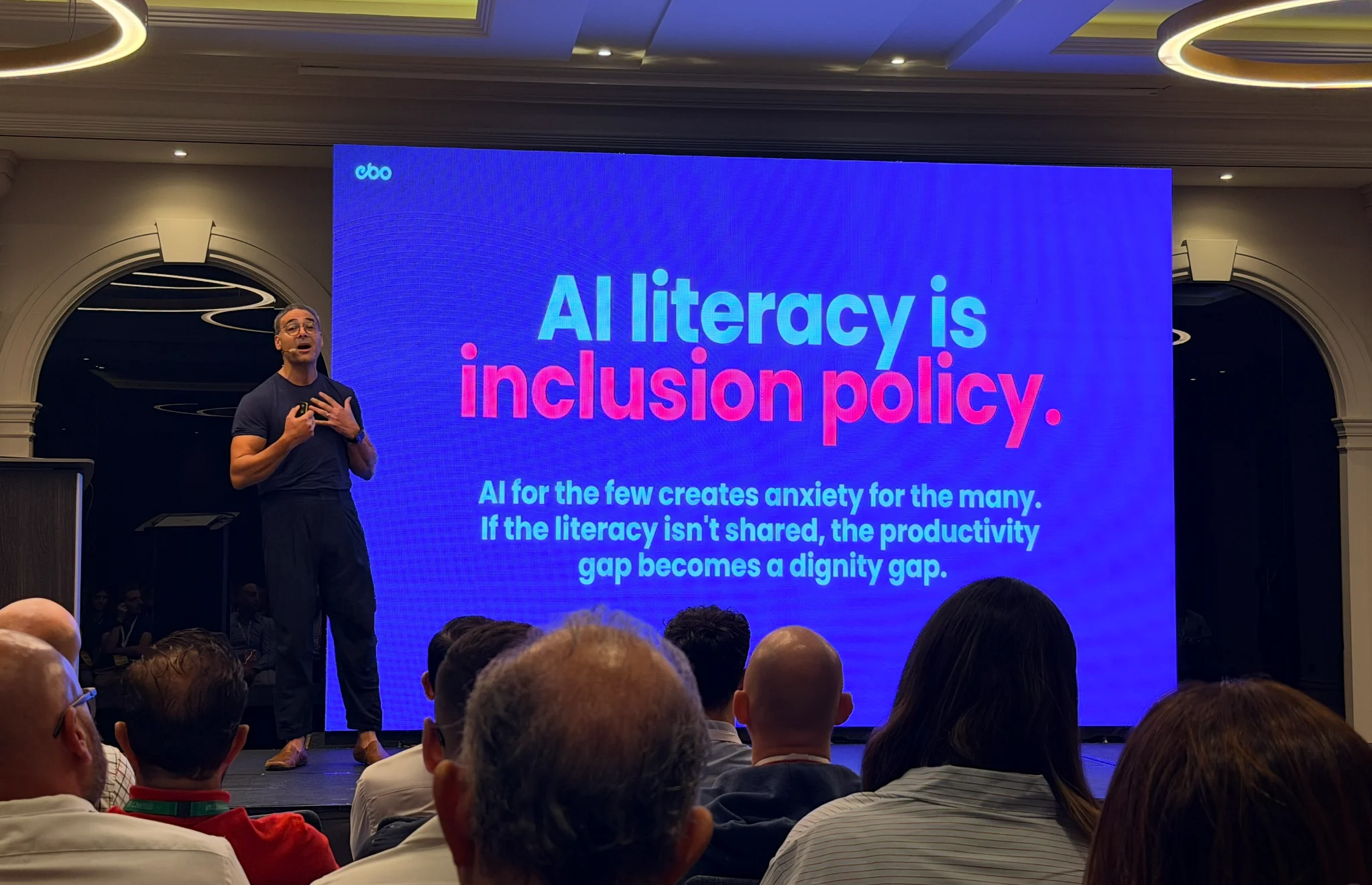
The day opened with Dr Gege Gatt, CEO of EBO, talking about building responsible AI for a human workplace.
One of the comparisons he used was spectacles.
Glasses are sophisticated pieces of technology, but once we put them on we don't spend the rest of the day thinking about the engineering sitting on our face. They simply become part of how we experience the world.
AI is heading in the same direction.
At the moment, we still talk about “using AI” as though it is somewhere we deliberately go. We open ChatGPT, Claude or another tool and consciously enter an AI environment.
That distinction is already starting to disappear.
AI will increasingly sit quietly inside the software, products and services we already use. It will influence recruitment, customer service, finance, learning, productivity and decision-making without people necessarily thinking about the technology underneath it.
Gege described the progression from recognition AI, which identifies patterns, through generative AI, which creates things, towards agentic AI, where systems begin to act.
That last shift changes the conversation considerably.
There is a big difference between asking AI to help draft something and allowing an AI system to influence whether somebody is hired, promoted, given access to finance or treated as a particular type of customer.
As the technology becomes less visible, the thinking and values behind it have to become more visible.
An organisation might say it values inclusion, fairness or accessibility, but increasingly those values will also be expressed through the systems it deploys. If the technology consistently produces outcomes that contradict what the organisation says it believes, then which one represents the real organisation?
That is where AI stops being simply a technology conversation.
It becomes a leadership conversation.
Removing friction without removing people
Another idea from Gege's session that stayed with me was that AI should be used to remove friction rather than simply remove humans.
That distinction matters.
There is an enormous amount of work that people don't particularly enjoy doing. Searching through information, moving data between systems, formatting documents, summarising conversations, organising tasks and carrying out repetitive administration all consume time that could be spent somewhere more valuable.
The opportunity isn't necessarily to design workplaces with fewer people in them.
It could be to design workplaces where people have more capacity for the things humans are particularly good at: judgement, relationships, creativity, communication, empathy and leadership.
That changes the productivity conversation too.
Saving somebody ten hours of administration is useful.
But what they can then do with those ten hours might be much more important than the efficiency saving itself.
Maybe they spend more time with customers.
Maybe they develop a better product.
Maybe they support somebody in their team.
Maybe they have the headspace to think properly about a difficult problem.
That is where the human value of AI starts to become much more interesting.
Why confidence matters as much as technical skill
Gege also talked about AI literacy as a form of inclusion, and that probably connected more directly with our own work than anything else in the opening session.
We often talk about an AI skills gap as though the answer is simply more technical training.
I think there is another gap developing alongside it.
A confidence gap.
Some people are already experimenting constantly. They will try a new tool without worrying too much about whether they get it right first time. They will test ideas, make mistakes, work out what is useful and gradually build their understanding.
Other people will see the speed of change and decide that this new world belongs to somebody else.
That matters because access to the technology doesn't automatically create access to the opportunity.
People need enough understanding to challenge the output. They need to know that AI can sound extremely confident while being completely wrong. They need to understand where human judgement still matters and when the technology is simply helping them get somewhere faster.
Most importantly, they need permission to experiment.
That is increasingly how I think about AI Activator.
We are not trying to turn everyone who comes through the programme into an AI specialist.
We are trying to create practical experiences that help people realise they can participate.
Give somebody a real challenge.
Give them access to the tools.
Let them work with other people.
Let them make something they didn't think they were capable of making.
Then ask them to stand up and explain what they have created.
The technology is important, but quite often the most interesting transformation happens in the person rather than the product.
I've started describing that part of the work very simply.
We create bravery.
Not in some grand sense. Just enough confidence for somebody to have a go, challenge themselves and realise they might be capable of more than they thought.
That feels increasingly important in a world where uncertainty is becoming normal.
AI can scale our strengths, but it can also scale our assumptions
Another significant part of Gege's talk focused on bias.
There is a temptation to describe bias in AI as a technology problem, as though it somehow appeared inside the machine.
But the machine learned it somewhere.
From our language.
Our history.
Our organisations.
Our decisions.
Our data.
That creates an uncomfortable possibility. Technology can take assumptions that were previously limited by human capacity and reproduce them at enormous scale.
A poor recruitment decision made by one person affects one candidate.
A poor pattern embedded into an automated recruitment system could affect thousands.
And once different systems start interacting, the consequences become even harder to see. Recruitment, financial services, marketing, employee performance and customer support may all rely on different forms of automated decision-making, each reinforcing patterns inherited from what came before.
That is why responsible AI can't sit solely with the technical people building the software.
It becomes a leadership, culture and design issue.
Gege offered three deceptively simple questions when thinking about an AI system:
Who benefits? Who is excluded? Who can appeal?
What I like about those questions is that they move us beyond simply asking whether something works.
They ask what happens to people when it works.
Inclusion has to start before the technology is built
I came away thinking there is another layer to this too.
Better and more representative data matters, but inclusion cannot simply mean improving what we feed into a model.
It also has to influence who gets to define the problem in the first place.
Who decided what needed fixing?
Who designed the experience?
Who tested it?
Who decided what success should look like?
That is one of the reasons I increasingly like bringing very different groups of people together.
Students with businesses.
Technologists with educators.
Founders with people working directly in communities.
People who understand systems with people who experience the consequences of those systems.
The quality of the question often improves before anybody even starts building the answer.
That is becoming an important part of how I think about AI & Tech for Good.
For me, it isn't simply about finding obviously positive applications of technology. It is about making the process of technological change more participatory.
The more people who have the confidence and opportunity to shape what comes next, the more interesting the outcomes become.
From responsibility to complete unpredictability
The closing session couldn't have been much more different from the opening keynote.
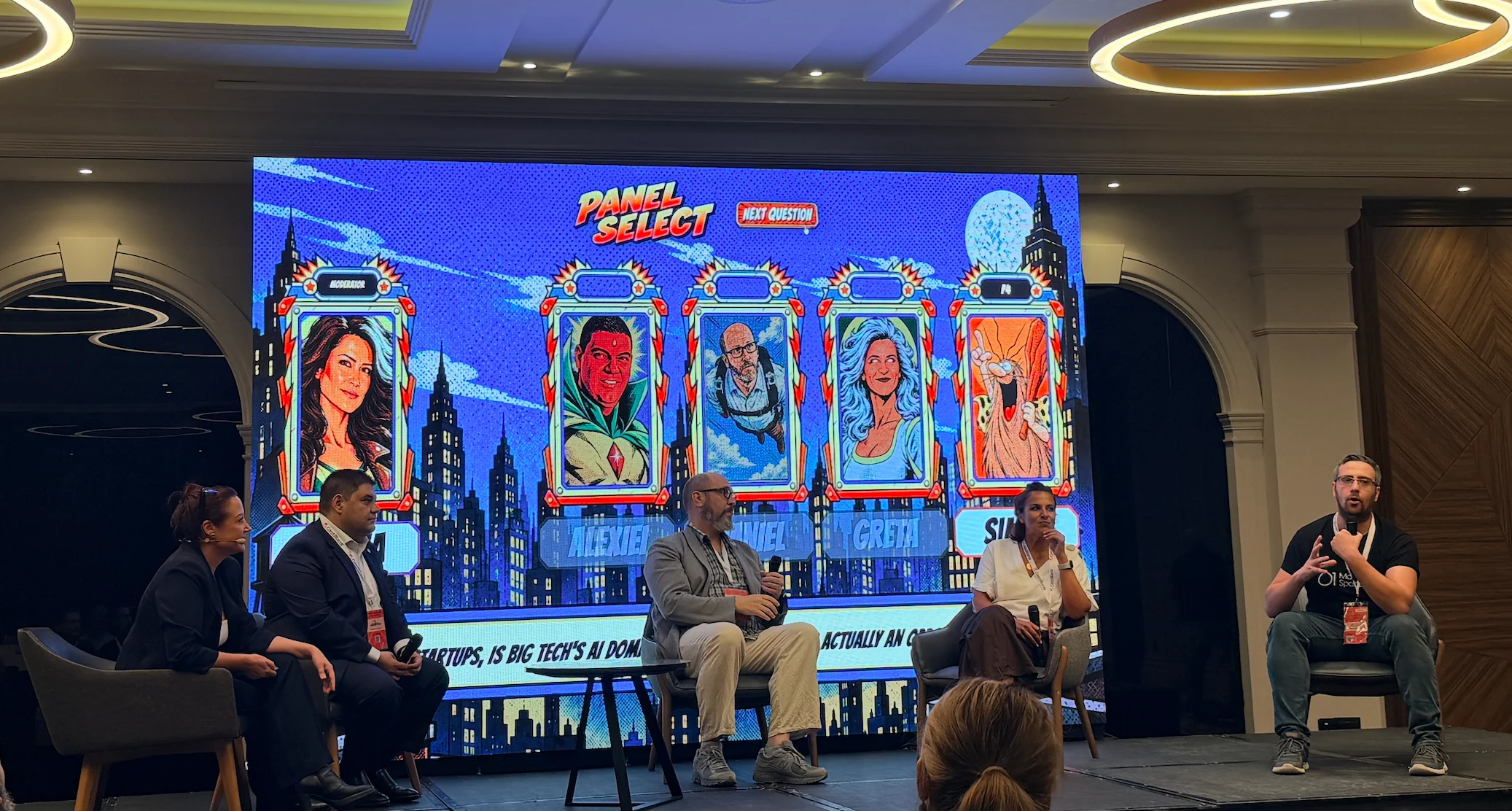
Instead of another conventional panel, TechTok finished with a game-show style session moderated by Alexia Stafrace, with Alexiei Dingli, Daniel Thompson-Yvetot, Greta Rapinett and Simon Theuma on the panel.
There were two spinning wheels.
One contained technology themes from across the conference such as AI, cybersecurity and cloud.
The other brought in comic-book ideas such as superheroes, supervillains, sidekicks and kryptonite.
The combination created a question and the panel had to respond.
No beautifully rehearsed answers.
No carefully prepared presentations.
Just experience, knowledge and the ability to think on your feet.
After spending the day hearing how sophisticated technology is becoming, there was something quite fitting about finishing by celebrating a collection of very human capabilities.
Adaptability.
Humour.
Experience.
Context.
The ability to connect different ideas quickly.
And the ability to deal with uncertainty.
In many ways it felt like a pretty good metaphor for where businesses are with AI right now.
None of us know exactly where this goes.
We need direction, but we also need to become much more comfortable operating in uncertainty.
The exciting opportunity might also be the boring one
The closing conversation moved through everything from AI and startups to cybersecurity, cloud infrastructure and blockchain.
One of the points I particularly liked was how much opportunity still exists in fairly ordinary business processes.
The AI conversation often jumps straight towards the huge transformational ideas.
Autonomous companies.
One-person unicorns.
Whole industries being reinvented.
Some of that may well happen.
But at the same time, thousands of organisations are still manually copying information between spreadsheets, searching through huge email chains, retyping handwritten notes and spending hours carrying out administrative processes that technology can already make easier.
That might sound less exciting than building the next great AI company, but the combined impact could be enormous.
Sometimes transformation isn't a spectacular new product.
Sometimes it is simply giving somebody two hours of their day back.
That links directly to the earlier conversation about friction.
The useful question becomes less about where we can deploy the most sophisticated AI and more about where somebody is currently wasting time doing something unnecessarily difficult.
Good technology can still create bad habits
The cybersecurity discussion brought a different perspective.
The obvious concern is that generative AI makes malicious activity more sophisticated. Phishing can become more convincing, language barriers are disappearing and social engineering becomes easier to personalise.
But there was another point that interested me more.
The better AI gets, the easier it becomes to stop checking it.
At first we inspect everything carefully.
Then it produces several good results.
Our confidence in the machine increases and gradually our own involvement reduces.
The software development example discussed on the panel illustrated that particularly well.
If an AI agent generates tens of thousands of lines of code and a human reviewer simply approves the output without realistically understanding what is there, technically we can still claim there is a human in the loop.
But the oversight isn't meaningful.
Somebody described it as almost becoming performance art.
That phrase stuck with me.
Because the same problem could happen almost anywhere.
Putting a person at the end of an automated process doesn't automatically make that process human-centred.
The person needs enough knowledge, confidence, time and authority to challenge what the machine has produced.
Otherwise we haven't retained human judgement.
We have simply created the appearance of it.
Then the wheel landed on me
Towards the end of the panel, I put my hand up and ended up getting one of the randomly generated questions.
The subject brought together human-centred design, speed to market and the idea of the supervillain.
My immediate thought was that sometimes the supervillain is us.
Partly because we can overthink things, but also because we are trying to move so quickly.
AI has created this feeling that everything needs to happen faster. We can write faster, build faster, research faster, prototype faster and produce more than ever before.
But just because the tools can move quickly doesn't always mean we should.
There is a danger that we become so focused on acceleration that we lose focus altogether.
A new model launches. A new platform appears. Somebody posts about the latest tool. Suddenly the thing we were using last week feels old and we start wondering whether we should switch again.
Then another one arrives.
And another.
I've started describing part of this as the Netflix effect.
You sit down knowing you want to watch something, but you're presented with thousands of possibilities. You browse, compare and keep looking until you've spent more time choosing something than you would have spent watching it.
AI can create exactly the same behaviour in businesses.
Which model?
Which platform?
Which AI strategy?
Which workflow?
Which shiny new thing should we be experimenting with next?
It becomes very easy to confuse activity with progress.
Sometimes the more useful thing might actually be to slow down.
Choose the tools that work for the problem you are trying to solve. Learn how to use them properly. Build some confidence and consistency around them. Keep moving towards the outcome you originally set out to achieve rather than continually changing direction because something newer has appeared.
That doesn't mean ignoring innovation.
Curiosity still matters.
Experimentation still matters.
But there is a difference between experimenting with purpose and constantly resetting because the next shiny thing has arrived.
The real advantage may not come from being the person using the newest tool.
It might come from being the person who has worked out how to use a good tool consistently and meaningfully.
That is where focus becomes as important as speed.
For me, the answer isn't simply to move faster or slower. It is to know what marker you're moving towards.
What problem are we actually solving? What needs to change? What would a useful outcome look like?
Once that is clear, technology can help us get there more quickly.
Without that focus, AI can simply help us create more options, more noise and more reasons to change direction.
That probably sums up quite a lot of the GoodShip* approach.
We believe in experimentation. Build something, test it, put it in front of people, learn from it and improve it.
But sometimes the bravest decision isn't to chase the next thing.
It's to stick with what you've chosen long enough to make it useful.
Malta and Liverpool have more in common than you might think
One of the other things that struck me throughout the trip was how familiar many of the conversations felt.
Skills.
Education.
Social mobility.
Startup growth.
AI adoption.
Productivity.
How developers' jobs are changing.
How young people prepare for a labour market that is changing incredibly quickly.
They are all conversations happening back home in Liverpool too.
The ecosystems are different, but many of the challenges aren't.
And that became one of the most valuable parts of the trip.
I had the chance to spend some time with TechTok organiser Calvin Cassar, and we talked about the crossover between our two home locations and where stronger connections between Liverpool and Malta could be useful.
Both places have growing technology communities, entrepreneurial energy, universities, creative businesses and people trying to solve some pretty significant economic and social challenges.
There are skills and experiences in Liverpool that could be useful to people in Malta, and equally there are things happening in Malta that Liverpool can learn from.
That doesn't mean one place has a model for the other to copy.
Quite the opposite.
The value comes from comparing approaches, sharing what is working, introducing people to each other and creating space for new collaborations to emerge.
That is where I think international relationships become genuinely useful.
Not another city-to-city statement.
Not networking for the sake of networking.
People working together because there is something useful they might be able to learn, test or build.
For GoodShip*, that is becoming particularly interesting as we think about where projects such as AI Activator could travel and how the communities around our work might connect beyond Liverpool.
A technology conference that left me thinking about humans
There was a nice symmetry to the day.
TechTok opened by asking us to think seriously about responsibility as AI becomes embedded in everyday life.
It closed by deliberately introducing unpredictability and asking people to work things out in real time.
Somewhere between those two ideas is probably the reality of what comes next.
The technology will keep moving faster than most organisations are comfortable with. New tools will arrive before we have completely understood the old ones. Some jobs will change, some processes will disappear and some of the assumptions we currently have about AI will probably look fairly ridiculous a few years from now.
The challenge isn't going to be predicting all of that perfectly.
It will be developing people, organisations and communities that are confident enough to adapt as it happens.
That means creating space for experimentation while still thinking seriously about responsibility.
It means using AI to make work better rather than simply faster.
It means ensuring that human involvement in technology is meaningful rather than ceremonial.
And it means widening participation so the next chapter of technology isn't shaped solely by the people who already have the greatest access to it.
That was probably my biggest takeaway from TechTok.
I spent a day surrounded by conversations about technology and came away thinking much more deeply about confidence, inclusion, judgement, creativity, participation and collaboration.
And the collaboration part is something I am particularly keen to continue.
I'm already looking forward to getting back to Malta later in the year, continuing the conversations with Calvin and others I met, and seeing what we can start connecting between Liverpool and Malta.
And who knows.
Maybe GoodShip* might even have a role to play in next year's TechTok.
That would feel like a pretty good next chapter.
Because the future isn't really interesting simply because of what machines will be able to do.
It gets interesting when people, organisations and places start working out what they can do differently together because the technology exists.
Related GoodShip* Activation
AI Activator
Don't just learn AI. Do something with it.
Explore AI ActivatorRelated GoodShip* Activation
KinShip
A community for people building useful things together.
Explore KinShipRelated GoodShip* Activation
Navigate
Liverpool Chamber of Commerce × GoodShip*, connecting the business ecosystem.
Explore NavigateRelated GoodShip* service
Consultancy
Explore Consultancy
Gavin Sherratt
Founder · GoodShip*
Team member
Gavin founded GoodShip* to bring good people, good ideas and useful technology together around work that can make a genuine difference.
LinkedIn